Call Us Today!
(647) 994 4698If you're considering installing a retaining wall, one of the first questions that likely arises is, "What will it cost?" A quick search reveals that in Toronto, the average price ranges from $35 to $65 per square foot.
This estimate provides a good starting point for budgeting, but it's just the beginning. The final cost will depend on various factors, including your choice of materials and the complexity of your site.

Before relying solely on a cost calculator, it's beneficial to understand the components that contribute to the total price. A retaining wall project involves more than just the visible blocks or concrete; it includes materials, skilled labor, and potential site-specific challenges. Understanding these elements can clarify any estimates you receive.
For those in Toronto, location can significantly impact cost. While the average cost is $35 to $65 per square foot, reflecting sturdy poured concrete walls, local markets have their own pricing nuances. For instance, you might see differences between neighborhoods, with some areas being slightly more or less expensive. For detailed information on retaining wall costs in Toronto, you can visit ProMatcher.
To simplify, let's review common pricing methods used by contractors. Familiarizing yourself with these metrics is crucial for building a realistic budget and effectively using any cost calculator.
| Pricing Metric | Typical Cost Range | Notes |
|---|---|---|
| Per Square Foot | $35 - $65 | This covers both materials and labor in an all-inclusive price. |
| Per Linear Foot | $140 - $260 (for a 4-ft wall) | Useful for quick estimates based on your wall's length. |
| Materials Only | $15 - $35 per sq. ft. | Covers the cost of blocks, stone, or concrete only. |
| Labour Only | $20 - $40 per sq. ft. | Varies based on crew experience and project complexity. |
This table helps you understand how different components contribute to the final cost. While the "per square foot" price provides a comprehensive figure, seeing the breakdown helps you track where your money goes.
Pro Tip: When obtaining a quote, confirm with your contractor if it's truly all-inclusive. Items like soil disposal, permit fees, or significant excavation could be excluded from an initial estimate, leading to unexpected costs later.
Ultimately, these numbers serve as a starting point. The materials you select—from budget-friendly concrete blocks to premium natural stone—and your property's unique characteristics will significantly influence the final cost.
Before using a retaining wall cost calculator, it’s crucial to understand the factors influencing the estimate. The final figure isn't arbitrary; it results from careful consideration of several core variables that impact your project's cost.
Consider the three main variables you can adjust to control your budget: the wall's dimensions, the materials you select, and the specific conditions of your property. Once you understand these elements, a cost calculator becomes a powerful planning tool, illustrating how your choices affect the final price.
The size of your retaining wall is the most straightforward factor affecting the cost. A longer, taller wall requires more materials and labor. However, it's the height that can significantly alter the cost.
When a wall exceeds four feet in height, it requires more than additional blocks. It necessitates substantial structural reinforcement, deeper foundations, and often a structural engineer to ensure it can support the soil's pressure. This can quickly increase costs, turning a simple landscaping project into a more complex construction task.
A decorative garden wall two feet high and 20 feet long is vastly different from a four-foot-high engineered wall of the same length. The taller wall could cost two to three times more per square foot due to the added engineering, excavation, and structural requirements.
This is where personal style and budget intersect. Your material choice can impact the total cost more than almost any other factor. A basic concrete block wall is practical and economical, while natural stone provides a timeless, high-end aesthetic at a higher price.
To illustrate, for a standard 100-square-foot wall, interlocking concrete blocks might cost between $2,500 and $4,000. Opting for natural stacked stone could raise the price to $6,000 or more due to the stone's higher cost and the labor-intensive installation.
To help you weigh your options, here’s a comparison of common materials. Choosing the right material involves balancing initial cost with the desired appearance and the wall's expected longevity.
| Material Type | Average Cost per Square Foot | Estimated Lifespan | Best For |
|---|---|---|---|
| Interlocking Concrete Blocks | $25 - $40 | 50-100 years | DIY-friendly projects and modern, uniform aesthetics. |
| Poured Concrete | $35 - $65 | 50-100+ years | Tall, structurally demanding walls needing maximum strength. |
| Natural Stone | $60 - $100+ | 100+ years | Creating a classic, high-end look for gardens or property borders. |
| Timber (Pressure-Treated) | $20 - $35 | 15-20 years | Budget-conscious, shorter walls in non-critical areas. |
This table highlights the trade-offs. While timber initially appears cost-effective, its shorter lifespan means you might replace it while a stone wall is still standing. Considering long-term implications is crucial when planning a permanent feature like a retaining wall. For inspiration on how material choice affects aesthetics, explore front porch retaining wall possibilities.
Finally, we consider the unique characteristics of your property, a significant factor that a basic online calculator might not fully account for. A flat, accessible backyard where a mini-excavator can operate is ideal for contractors.
Contrast this with a steep, inaccessible backyard. Every concrete bag, block, and dirt shovel must be moved manually or with smaller equipment, increasing labor hours and potentially adding 20-30% or more to the total project cost compared to an easily accessible site.
Here are common site-related challenges that can increase costs:
Understanding these three pillars—dimensions, materials, and site conditions—is key to using any cost calculator effectively and creating a budget that reflects your project's realities.
When you first use a retaining wall cost calculator, major expenses like blocks, stone, and labor are evident. However, these figures rarely capture the full scope. Often, the essential groundwork and post-construction tasks are the real budget challenges.
These are the "hidden" costs, distinguishing a professional, durable wall from a DIY project prone to failure. Overlooking them is a common mistake. Let's uncover these crucial, often surprising, project costs.
Before construction can begin, the site must be prepared. This involves more than just clearing grass. It's the foundational work ensuring your wall has a secure base.
Site preparation can be a major undertaking. A professional crew will have a checklist of tasks:
These steps require specialized equipment and expertise, adding significant labor hours to the project cost.
Cutting corners on drainage is unwise. Water is a retaining wall's biggest adversary. Hydrostatic pressure from waterlogged soil can cause even the strongest structures to fail.
A professionally built retaining wall incorporates a complete drainage system. This involves key components that, although costly, are essential for a lasting structure.
A wall without proper drainage is bound to fail; it's just a question of when. Investing in a robust drainage system initially is the best way to prevent costly future repairs or rebuilds.
Essential drainage components include:
These materials, though seemingly minor, add vital costs and labor to your budget. For more on the specialized techniques involved, learn about our professional masonry services to see how we build long-lasting systems.
Administrative aspects of the project, often overlooked, can add substantial expenses. For walls over a certain height (typically three to four feet in most areas), building permits and a structural engineer's plan are usually required.
These regulations exist for safety. In Toronto, retaining wall costs are often estimated by linear footage, with prices ranging significantly depending on complexity. Permitting fees, ranging from $1,000 to $4,000, cover engineering reviews and inspections. For more insights on Toronto retaining wall regulations, visit Dalinghaus Construction.
While these fees may seem like another bill, they ensure your wall is designed and built to withstand natural forces and comply with safety codes. Including these "hidden" costs in your budget from the start provides a realistic financial outlook for your project.
An online retaining wall cost calculator is a great starting point for budgeting. It simplifies a complex project into a few variables. However, to get a trustworthy number, you must use it correctly and understand what the estimate means.
Think of it as an interactive planning tool. By experimenting with materials and dimensions, you can see how your preferences affect the cost. It helps find the balance between your dream design and budget—all before contacting a contractor.
As you can see, it boils down to three key steps: accurate measurements, material selection, and getting a detailed estimate.
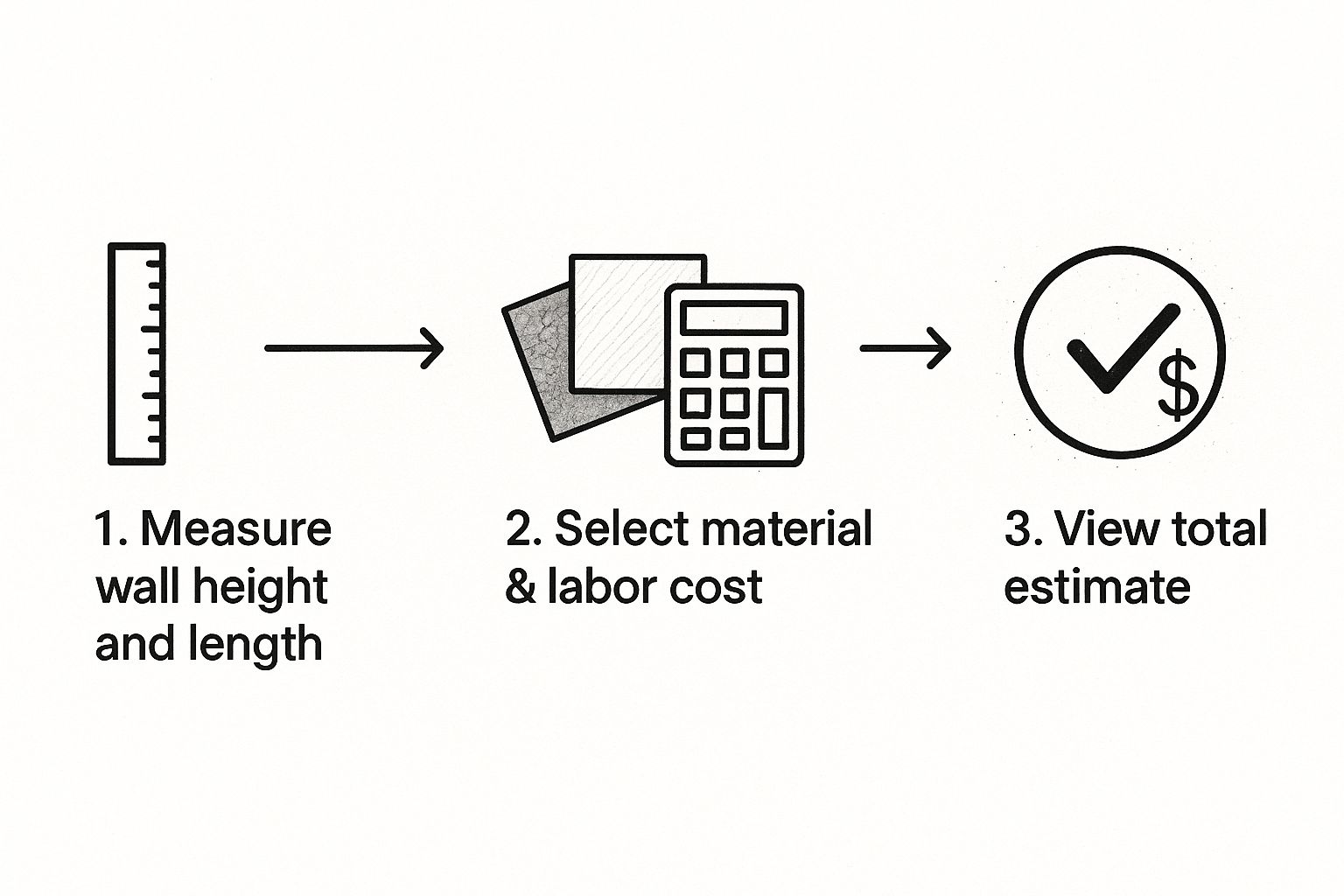
The saying "garbage in, garbage out" holds true for cost calculators. Your estimate's accuracy depends on the numbers you input. Measure carefully to get precise wall dimensions.
For example, if you have a gently sloping backyard and plan a wall 40 feet long and 4 feet high on average, these numbers form the foundation for the calculator.
Once your dimensions are set, explore how different materials affect cost. A good calculator offers options like interlocking blocks, poured concrete, or natural stone.
Using our 40-foot by 4-foot wall example, which equals 160 square feet, observe the cost variations:
This demonstrates the budget impact of material choices. Beyond materials, the best calculators allow consideration of site conditions. Look for options like "Site Access" (Easy, Moderate, Difficult) or "Slope" (Flat, Moderate, Steep).
Pro tip: Be honest about your site. Selecting "Easy" access for a lower estimate, when you know it's challenging, will lead to surprises when actual contractor quotes arrive.
After inputting data, the calculator provides a cost breakdown. This typically includes material and labor estimates, plus a total project cost. Understanding each part is essential.
The material cost is often accurate, based on square footage and material choice. The labor cost is more variable, an educated guess considering job complexity, access difficulty, and regional rates.
The final number is a valuable budgeting tool. It's not a binding quote, but it offers a realistic baseline. With this, you can engage with contractors confidently, asking informed questions and understanding their professional quotes.
With your numbers and material options entered into the calculator, you're now looking at a final figure. What's next? It's tempting to see that number as definitive, but it's best viewed as a starting point—your first step in forming a realistic project plan.
Consider the calculator's output as a solid ballpark figure, providing a reality check before making calls. However, it can't predict what's underground. Surprises like tough soil or old utility lines surface only during excavation.
That's where smart financial planning becomes crucial.
Experienced contractors advise always having a contingency fund. This isn't about inflating costs; it's a safety net for inevitable construction surprises. A good rule of thumb is adding 10-15% to your calculator's estimate.
If the calculator suggests $9,000, your contingency fund should be between $900 and $1,350. This buffer transforms potential crises—like needing extra gravel for wet soil or dealing with obstinate roots—into manageable issues.
The calculator estimate is your budget's foundation. The contingency fund is its protection. Proceeding without one turns minor issues into major crises.
With your estimated budget and contingency fund ready, you're well-prepared to approach local contractors. Your generated number isn't just for you; it’s a crucial tool for initial discussions. It shows you've researched and have a realistic budget.
When you begin the conversation, express confidence: "I'm planning a 160-square-foot wall, and my research suggests a cost around X. Does that align with your experience?" This sets a professional tone, helping you quickly identify contractors whose prices deviate significantly.
Keep in mind, local market conditions greatly influence costs. Building retaining walls in Toronto often carries a different price tag due to local regulations and cost of living. Poured concrete walls might range from $47 to $64 per square foot, reflecting higher labor costs and building codes. For more details on Toronto retaining wall costs, visit ProMatcher.
A formal quote should be more than just a number. To compare bids effectively, you need a detailed breakdown. Use your estimate as a baseline and ask contractors critical questions to uncover hidden costs.
A transparent, comprehensive quote helps you understand the full scope of work, from beginning to end—similar to the detailed approach in our interlock paving projects.
Here’s a checklist for those conversations:
Armed with this information, you're not just a homeowner with an idea. You're an informed client ready to hire the right professional, ensuring your retaining wall project succeeds.
Even after using a calculator, it's normal to have additional questions. Budgeting for a major project like a retaining wall involves many variables, and you want to be confident before starting. We understand.
Think of this as the next conversation you’d have after the initial estimate. We've compiled common questions from homeowners to help fill any gaps in your project plan.
This is one of the most frequent—and crucial—questions. The short answer is: it depends, but always assume you might need one.
Height is usually the deciding factor. In most of Canada, including Toronto, a building permit is required once a retaining wall exceeds 1 metre (about 3.3 feet).
However, height isn't the only consideration. A permit might also be necessary if the wall is near a property line, needs to support extra weight (a "surcharge"), or is in an environmentally sensitive area. Navigating local bylaws can be complex. A professional contractor's expertise in local regulations is invaluable, handling permits and ensuring compliance from the start.
Skipping the permit process to save money is a costly mistake. It can lead to stop-work orders, fines, or even the need to dismantle the wall. Always consult your local building department before starting construction.
The DIY approach is appealing, especially when you see labor costs. Yes, you can save on labor by doing it yourself, but a cost calculator won't show the significant risks and trade-offs.
Building a retaining wall is more than stacking blocks. It requires knowledge of soil mechanics, drainage, and construction methods. An improperly built wall isn't just unattractive; it's a safety risk that can fail, causing damage or injury.
Before choosing DIY, consider:
For small, decorative walls under two feet high, DIY might be feasible. For anything structural, hiring a professional is a wise investment.
The timeline varies significantly based on the project's size and complexity. For a standard project—a 30-foot-long, three-foot-high wall—a professional crew might finish in three to five days, weather permitting and with easy access.
Conversely, a large, engineered wall—70 feet long and five feet high on a challenging site—could take two to three weeks or longer.
Factors affecting the timeline include:
A contractor's quote should include an estimated timeline, with transparency about potential delays and regular updates.
Ready to transition from an estimate to a solid plan for your property? The expert team at Joey's Landscaping is ready to provide a detailed, professional quote and guide you through your retaining wall project.